On Becoming a Creative Visionary and an Integrated Leader
The people who see what everyone else misses, and the people who can lead a divided room, share one trainable inner stance.
What you're about to read will become the one skill that defines the leaders, innovators, and high-integrity humans of the next generation.
It's the only stance that can make an impact while actually countering a world increasingly in chaos. And one question tells you how much of it you already have.
How do you become the one who sees the new thing first, and the person other people call and send in when things get hard?
This entire treatise is about how to consistently find the idea that solves the problem everyone else is stuck on. To see the data point and make the call that no one else saw coming but that turns out to be right. It's about knowing what you need to know in the exact moment you need to know it, and feeling the inspired pull to act on it instead of second-guessing everything for another month or longer.
As a collective, we tell ourselves three stories about the people who are able do that on command: We think those type of people simply out-work everyone, or they're smarter, or they were just born that way. Grit, genius, or luck of the draw, and you already know which one you think you got.
But all three stories are wrong. What the most impactful people in the world have is a trainable skill. By the end of this page you'll know exactly what it is, and you'll know whether you're the kind of person who's built to excel at this way of showing up.
And if the word leader doesn't fit you, hold on. Maybe you don't want a stage or a title. But you probably want to be a good friend. A good partner. The mentor someone remembers twenty years later. Useful to the people around you, with a life that feels meaningful. In this system: that's leadership. The person everyone calls when things feel hard or start to spiral is leading, whether or not they'd ever use the word. Integrated leadership and creative visionaries hold the same posture, and this treatise is about how to develop that posture and whether you already have it.
An unwinnable situation
Who do you send in?
Picture it from the inside. You've built something to help a group of people you care about, and it's about to lose all of its funding. Twenty million dollars is on the line. The man who controls the purse strings has already made up his mind. The lawyers didn't get through to him. The arguments didn't. The pleading, the data, the negotiation, none of it. He's sat through two days of people trying, and he's bored. You get six minutes. Who do you send in?
Notice what the situation doesn't call for. You can't outthink him; smarter people than you have already tried. You can't out-feel him either. Protesting, raising your voice, throwing a fit, throwing rocks at the man with the pen, all of that just gives him a reason to stop listening. What you need is a person who isn't divided inside. An integrated leader. Someone who can walk into a room that wants a fight, feel everything in it, and stay clear.
That's exactly what happened in the spring of 1969. Public television was about to lose twenty million dollars, and the man holding the knife was a senator named John Pastore, famously gruff and impatient, who had never watched a minute of children's programming. Then a soft-spoken man in a cardigan sat down across from him. Fred Rogers.
Watch what Mr. Rogers didn't do. He didn't argue the budget. He didn't flatter the senator or attack the cuts. He didn't perform outrage. He told the truth about what he did, plainly: that every day he looked at one child through a camera and tried to show them they were cared for, and to help them understand that their feelings could be named and handled. Then he described a song he'd written for children about what to do with anger, about being able to stop yourself when you've planned something wrong and choose something else instead.
Six minutes. No charge in it anywhere. And the toughest man in the room said, on the record, that he was supposed to be a pretty tough guy, and this was the first time he'd had goosebumps in two days. Then he told Rogers it looked like he'd just earned the twenty million dollars.
Look at what it took. Not cleverness. Not force. A man whose head and heart weren't at war, so nothing leaked, so the truth came out clean enough that a hostile senator relaxed and heard it. Rogers had done the inner work for decades. He walked in already at peace with himself, and the room became whole.
One person who wasn't divided inside walked into a divided room, and the room stopped being divided. That's the person you want to be when it's your twenty million on the line.
What he had
It comes down to three abilities
Rogers wasn't smarter than the lawyers who failed before him, and he didn't care more than the people who pleaded for two days. What he had, and what every person in this treatise has, comes down to three abilities:
- The ability to stare into a paradox without immediately reacting.
- The ability to hold more than one perspective without immediately blurting out your position or stance.
- The ability to hold space for a hard problem without your attention sliding off to something easier.
This page takes about twenty-five minutes to read, and that's on purpose. A person who can do those three things should be able to sit with an important concept for twenty-five minutes. If you make it to the end, you've already shown you're more aligned with what's below than most people will ever be. If you can't, that's useful to know too, and we'll outline ways to strengthen your posture as we go.
One more question before you keep reading
Do you know why holding two opposing ideas at once makes you win more often?
Everything on this page comes down to that question. Can you hold two or more different or conflicting ideas at once? Two ideas that both seem right and wrong from different angles. Two people you love, each telling you a different story. A feeling that says run and a thought that says stay. Can you hold both in uncertainty without needing to crush one to feel immediate relief?
Most people can't, and it isn't a character flaw. It's a user settings problem. Every one of us runs on two engines, a heart that feels and a head that thinks, and when they aren't working together, one of them grabs the wheel. Watch what that looks like on an ordinary day, because if you live in any of these, you aren't the thing you want to be. Not yet.
When your feelings are at the wheel alone
- You send the text at eleven at night and frantically reread it at seven in the morning.
- You decide big things fast, call it trusting your gut, and then spend a year second-guessing the decision.
- You're certain, loudly, and ten minutes later you're afraid you said too much.
- Any criticism, however small, feels like an attack, so you answer it like one.
- You pick a side on every issue before the other person finishes the sentence.
When the head's in control by itself
- You say "I'm fine," but your jaw says otherwise.
- You've made the pros and cons list three times, and you're still standing in the same spot.
- You need to be certain before you act, so you mostly don't act.
- Sarcasm is your default setting, and you call it a sense of humor.
- You win the argument and lose the evening, and you'd do it again.
- You can't say "I don't know" out loud without it costing you something.
Every line on both lists is a person who can only hold one thing at a time. The feelings-at-the-wheel person has to act on the feeling to get rid of it, it's too uncomfortable. The head-in-control person has to shut the feeling down to think straight, different response to the same discomfort. Get it out of your body, or shove it down. Neither of them ever has room for two conflicting things, which means neither of them ever has room for a new idea to pop in. That's the disqualification, and most people fail in this way every day.
It's a setting, though, and settings change. Keep reading and you'll notice another setting running in the people you already admire.
The case for being visionary
What a visionary actually has
Rogers had it in a hearing room. Einstein had it in a patent office. He didn't grind his way to relativity. He daydreamed it. At sixteen he imagined riding alongside a beam of light. Years later, in a patent office chair, he pictured a man falling off a roof and realized the falling man wouldn't feel his own weight, and he later called it the happiest thought of his life. Modern physics came out of a man staring, unhurried, at a picture in his mind, holding two things that couldn't both be true until suddenly they could. He said it himself: imagination matters more than knowledge.
Niels Bohr, who rebuilt physics a second time, liked to say the opposite of a profound truth may be another profound truth. He wasn't being clever. He was describing the state he worked in.
Underneath the hustle and the brains, every real visionary runs on the same engine: the ability to make space inside themselves, stare at a paradox without flinching or picking a side, and let something arrive. That's an emotional stance before it's a mental one, and it's the whole secret.
Notice what that means. A stance isn't a gift. You weren't born with it or without it. Einstein wasn't born daydreaming about light; he practiced opening his imagination for years, until pictures started flowing in, while the rest of the patent office filed paperwork. A stance is something you show up to, and anything you can show up to, you can train.
A visionary is someone who can hold two things in mind at once without attacking either.
The case for integrated leadership
The legends we most admire held both sides
Throwing rocks at one side is cheap, it feels like power, and everyone does it. Holding both sides costs something, and it's the only thing that has ever healed or built anything meaningful. Rogers wasn't the only one. Five more people make the case.
"Both read the same Bible and pray to the same God, and each invokes His aid against the other."
Abraham Lincoln, second inaugural, 1865
Four years into a war that killed six hundred thousand people, with every reason to name a villain, he refused. He held both halves of a broken country inside himself and asked it to bind up its wounds "with malice toward none." He could do that because he was present with the hard thing instead of running from it into blame.
"Hate cannot drive out hate; only love can do that."
Martin Luther King Jr.
He had every reason on earth to throw the charge back. He told the truth to the people hurting him without a drop of projection in it, and it moved a nation in a way that force never could.
"How can you hate me when you don't even know me?"
Daryl Davis, blues musician
A Black man who has spent more than thirty years sitting down with members of the Ku Klux Klan, not to argue, just to ask that question and then listen to the answer. He holds their hatred and his own dignity in the same room without picking either one up to throw. By his count, more than two hundred of them have since handed him their robes.
"No future without forgiveness."
Desmond Tutu
After apartheid, South Africa could have gone the way broken countries usually go. Instead Tutu chaired a commission where the people who did the harm told the whole truth out loud, in front of the people they'd harmed, and the country held the truth and the forgiveness at the same time. It's still the most ambitious attempt in history to heal a nation by telling the truth instead of taking revenge.
"The most important quality for an investor is temperament, not intellect."
Warren Buffett
The most beloved businessman alive built the greatest track record in history and credits it not to being the smartest in the room but to temperament: feeling the fear and greed everyone else is drowning in, and not being run by it. He stays calm when the market panics, tells shareholders the plain truth about his own mistakes every single year, and is giving nearly all of it away. Head and heart in the right order, out loud, for sixty years.
None of those five were weak. They had a floor under every uncomfortable feeling that let them say the true thing into the most hostile rooms of their time, and the rooms changed. Which raises an obvious question about the rooms we're in now.
Why nothing gets done anymore
A country with no center
Look at any political argument this week and you'll see the two lists from the top of this page, scaled up to a nation. One side runs on order, structure, limits, and the argument. The other runs on feeling, empathy, the person in front of you, the story. Call them head and heart, or if you like, conservative and liberal. Of course it's a spectrum, and this is a caricature, but in general each one carries the exact half the other is missing, and each one has decided the other half is the enemy.
What's gone missing is the center. Not a mushy middle, and not splitting the difference. The center is what happens when the head makes a container big enough for the heart, when the structure exists to hold and explore discomfort instead of shutting it down in favor of comfort. But discomfort is the only place a meaningful decision actually gets made. Without it you get what we have: everyone talking at once, no one able to hear, and nothing moving. There's an old story about exactly that, with a tower in it, and we'll get to it in a bit.
But the thing that's true of a country is true of you. A room full of divided people is a room full of people who are divided inside. The two halves have to work together in you before they'll ever work together between you and anyone else. Lincoln, in the speech that made him famous, quoted a line from Jesus that most people don't know comes from the Bible: a house divided against itself cannot stand. He meant the country. But it's even more valid of a person and their internal voices.
The thing you might have missed
The visionary and the leader are the same person
Look back at Rogers. He invented a kind of television that didn't exist before him, which is the visionary's job. And he moved a hostile senator with six minutes of plain truth, which is the leader's. Same man, same afternoon, same stance. Einstein staring at a paradox until it resolved and Lincoln staring at a split nation until he could hold both halves were doing the identical thing inside: making a space wide enough for two true things, and holding it long enough for a third to arrive.
That's the whole secret, and you can stop here if you'd rather keep believing it's a gift. The rest of this page is about how a person gets that way, and it starts with a question that sounds like it has nothing to do with any of this.
A strange question
Who can you cry in front of?
Who can you cry in front of and not feel ashamed? Not the most impressive person you know. Not the most useful. The one you could fall apart in front of, ugly and unguarded, and feel no need to apologize to afterward. Hold a name in your mind. We'll come back to that person.
Now ask why you chose them. It's because you don't police yourself around that person. You don't rehearse your sentences, brace for their reaction, or wonder what they're deciding about you. You can be wrong in front of them. You can say the half-formed thing. You can tell the risky joke. You trust, without ever having decided to, that they won't rush to judge you. So you relax. And the moment you relax, you can let go.
That person is showing you, in the flesh, how your own heart and head are supposed to work together.
The space they make for you is the space a visionary makes inside themselves. The relaxing that lets you cry in front of them is the same relaxing that lets a new idea arrive. No self-policing. No bracing. No rushing to judgment, not even of your own thoughts. They have that stance toward you. The visionary has it toward their own mind.
And the crying itself isn't the point. What it does is the point. Something that's been sitting in you, often for years, finally moves, and it was jamming the line between what you feel and what you know the whole time. You know the far side of it. Lighter. Clearer. The decision that was impossible yesterday is suddenly obvious. The idea you'd been straining for shows up on its own. That clearing is what a visionary does on purpose, over and over, until it's simply how their mind works.
Four rooms
Your best ideas already have an address
Take the person you named and insert them or someone like them into your week. In every room, there's one person you don't perform for. Watch what happens to your thinking in that room.
Your business
Who do you tell the real numbers, the deadline you'll miss, the idea that isn't working? Everyone else gets the managed version. But the fix only ever shows up in the conversation where the real version is on the table even when it's ugly.
Your job
Who can you say "I don't know" to? That's the one meeting where you stop defending and start thinking. It's the meeting your best idea of the quarter comes out of, and that isn't an accident.
Your relationship
Who has seen you tired, scared, wrong, and still stayed? Around that person you can dream out loud, which is the only way anyone ever thinks anything new.
Your family
Who do your shoulders drop next to at the table? Notice you're funnier with them. Quicker. Funny and quick are what a clear signal looks like from the outside.
It's the same kind of person every time, the same result every time. Where you can stop guarding, you tell the truth, and where you tell the truth, the ideas come. The visionary has simply found a way to live in that room all day. Not with one person. Inside their own head. Which lets them live that way with everyone else.
The name for it
Presence
What that person has isn't warmth, exactly, or patience. It's presence. And presence has a precise definition, not a vague spiritual one.
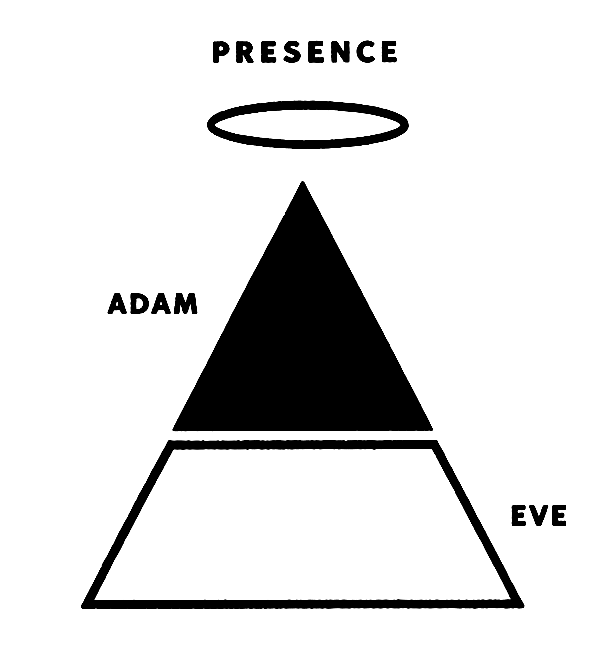
It's what happens when your thinking mind and your feeling nature stop fighting each other and start working together. The oldest story in the Bible gives these parts of yourself names. Adam is the head. Eve is the heart. And God is the presence the two of them meet when they show up in the right order: the feeling arrives first, the head makes room for it instead of shoving it down, and in the space between them, something gets handed to you. You've been living that story every day of your life without knowing it had a name.
Most people run from one side or the other. Eve grabs the wheel and they lurch: they snap, they blurt, they dump. Or Adam smothers Eve's feeling and they freeze: they go polite, go quiet, go "fine." That's the two lists from the top of this page, and now you know what they're really a picture of. A present person does neither. They feel the thing fully and think clearly at the same time. The person you can cry in front of is Adam and Eve in the right order, and you can feel it from across the table.
That's why you relax around them. There's nothing leaking. No charge under the words, no judgment loaded into the pause. Their calm isn't the absence of feeling. It's feeling, with a floor under it. And a person like that does something rare: they make space. Space you can fall apart in. Space you can tell the truth in. Space, it turns out, that creativity rushes in to fill.
Proof at scale
The most valuable community on earth is built on nothing but space
In 1935, two drunks in Akron, Ohio figured out that neither of them could stay sober alone, but they could if they told each other the truth. Ninety years later, Alcoholics Anonymous runs in nearly every country on earth with no dues, no bosses, and no advertising. Lives depend on it, and it works.
What it sells is structured intimacy. Anonymity, so nothing you say can be used against you. The same steps for everyone, so no one's performing. A room full of people in the same trouble, so you can say the unsayable and no one flinches. Strip the folding chairs away and what's left is the thing you have with the person you named: a space where you can be fully yourself, built on purpose.
A present person is a walking version of that room. They create the space wherever they go, and eventually, inside their own mind.
What the space is for
Truth is close to a cure-all
Telling the truth is the fastest route to almost everything. It's the fastest route to a solution, because most problems are just the gap between what's happening and what everyone's pretending is happening. It's where the funniest jokes live because pointing out the thing everyone was thinking but too afraid to say creates relief. Laughter is relief. Truth always shows you, instantly, what you've been avoiding feeling. And it collapses time: the conversation you've put off for a year is over in four minutes, and the year was the price of not having it.
But very few people know how to tell the truth like this, because there's a counterfeit that feels exactly like truth from the inside.
Most people who think they're telling the truth are projecting. They take an uncomfortable feeling they never felt through, the hurt, the fear, the resentment, and throw it at someone with the word "honestly" in front of it. That's a feeling in a costume, and the whole room tightens up, because something just got thrown.
The difference between truth and projection is presence. Feel the charge all the way through first, and what comes out is just the true thing, clean. People can hear it. They relax, even when it's hard.
Why you're not that person yet
Presence has counterfeits, and each one feels like strength
Send one honest text to the people in your life and watch what comes back. You'll recognize every one of these characters.
The Projector
The Pleaser
The Fixer
The Blamer
The Ghost
The one who makes space
Every reply but the last one is a way of escaping the present moment discomfort while looking like you're meeting it. The Projector escapes into blame dressed as honesty. The Pleaser into pleasantness. The Fixer into solving. The Blamer into whose fault it is. The Ghost just leaves. Each of them is tightening the room. Each of them is a lurch or a freeze with a personality.
And each has a way back into the present moment, which is always a single honest question:
- The Projector. What am I actually feeling right now, and where is it in my body?
- The Pleaser. What's the true sentence I just didn't say?
- The Fixer. What if nothing needs fixing yet?
- The Blamer. What part of this is mine to feel?
- The Ghost. What am I afraid will happen if I stay?
What's running underneath
The programming a present person runs on
- The answer is underneath the feeling, not above it. You've never once thought your way to peace. You've only ever felt your way there.
- Nothing has to be fixed before it can be felt. The fix is usually what you reach for to avoid the feeling.
- What you won't feel, runs you. Every unfelt thing is at the wheel, and you're in the passenger seat calling it your personality.
- Truth spoken clean is the fastest thing there is. It collapses the year into the ten minutes.
- You can hold both. Two conflicting things, two sides, two feelings at once. The capacity to do that is the whole difference between a visionary and everyone else.
The question turns around
Can you be that person for your own head and heart?
Is there anyone who can be fully themselves around you, wrong, unfinished, at their worst, and relax? Are you making that space for a single person in your life?
And it's the question that decides whether you ever become a visionary. Can you give your own thoughts that same space? When a half-formed idea shows up, do you police it, judge it, fix it, or dismiss it before it's finished? When a hard feeling shows up, do you project it onto your day, blame someone for it, or go quiet and disappear? Or can you let it sit there, unjudged, and stay with it?
Every idea that ever changed the world was, for a moment, a bad idea that someone didn't attack.
Presence with others is downstream of presence with yourself. The person everyone can be honest around, and the person ideas keep arriving to, is simply someone who stopped being at war inside.
The decision you've been circling
Stare at every option, including the ones you hate
Bring this home to the decision you keep turning over. The reason it won't resolve isn't a lack of information. It's that you can only bear to look at some of the options.
The choice you're afraid of, the one that would upset someone, the one that admits you were wrong: you flinch away from those before you've even looked. So your data is skewed. You're weighing a menu with half the items torn off, and wondering why the math never works.
A present person can stare at every option without reacting to any of them. Even the options they don't want. They let each one land, feel what it stirs, and read that feeling as information instead of a verdict. That puts everything back on the menu. It gives them empathy for the people around them. And only when everything is on the menu and you understand everyone's perspective can you actually see the real odds of each path.
Decision-making is the ability to look at the whole menu without flinching. Flinching is the only thing that was ever keeping you stuck.
Then something strange happens, and every visionary knows it. Once you can look at the whole menu, you stop needing to figure out the answer. It just shows up. Once you're emotionally settled in presence, you end up knowing what you need to know at the very moment you need to know it, and you feel a pull toward the next step that isn't anxiety and isn't a plan. The Bible has a word for this. Provision. Manna in the desert, enough for today, delivered on time, and in the story it rots if you try to hoard it. The overthinker tries to stockpile answers for a future they can't see. The visionary trusts the answer will be there when they arrive, because it always has been every time they find presence.
A creative visionary isn't someone who knows more. It's someone who's learned to receive what they need when they need it, and to act on it the moment it arrives.
Where it goes from there
Order yourself first, and it spreads
Once your own inside is in order, heart felt, head making room, something arriving, you'll notice you start holding the same space for the people closest to you without trying. Your partner relaxes around you. Your kids tell you the real thing. Then the team does. Then the community you're part of, then whatever's bigger than that, as far as your reach goes: a city, a state, a country, maybe the whole collective mind. Not because you campaigned for it. Because order spreads from the one place it exists inside, and moves outward, in concentric rings.
Someone who organized their own inside first carries that order into every room they walk into. That's an integrated leader. That's a creative visionary. And now the only question left is whether you're actually capable of living like that.
Now let's test it
The map for being a visionary is in the Bible. And watch what just happened inside you.
You felt it. Some of you flinched. Some of you got interested. And some of you just decided this whole page was a setup and reached for the back button.
Stay with that reaction for a second, because it's the test. You've spent twenty minutes agreeing that a visionary holds two conflicting things at once without attacking either, and that a leader can sit in a hostile room and not throw a rock. Then one word showed up, "Bible", and many picked a side before the sentence was finished. That's the feelings-at-the-wheel list. Or you went cool and skeptical and filed it under religion, which is the head-in-control list. Either way, for one second, the word "Bible" knocks many out of the visionary role.
So stay with it through the flinch, because the flinch is the test. You already know that parts of the Bible, read literally, are indefensible, and I'm not going to ask you to defend them. Hold that objection in one hand.
Now let's hold the other idea at the same time. What you're looking at when you open the Bible is actually the largest, oldest, most ruthlessly stress-tested record of what happens inside a human being ever compiled, written long before anyone had the words trauma or nervous system. So they did what every culture before science did. They put it in stories. And the stories are full of people who can't agree, a God who seems to contradict himself, two accounts of the same event sitting side by side. It's a book of conflicting viewpoints. And that's exactly why it's the right practice ground. A book everyone agrees with can't train what we're talking about here.
If you can't hold "a lot of this is indefensible" and "this might be the most useful thing I've ever read" at the same time, you missed the plot.
The paradox you didn't expect
Every character in it is a part of you
Read as history, it's about other people in a desert a long time ago. But read as a mirror, every character is a part of you, every place is a state you've been in, and every story is happening inside you this week. Watch it work.
The tower. In Genesis, everyone on earth is building the same tower toward the sky, and then suddenly they can't understand a word each other says. "Come, let Us go down and confuse their language, so that they will not understand one another's speech." That's the comment section. That's Thanksgiving dinner. That's Congress. Babel is what happens when the head builds an identity from the outside in and loses the heart underneath it, and it's the country with no center from a few minutes ago, written down three thousand years early.
Pharaoh. God tells him to let the people go, hardens his heart so he won't, and punishes him for it. Cruel, if Pharaoh is a man in Egypt. But Pharaoh is the part of you that won't let the old life go, and it digs in hardest the morning you decide to quit the drink, the job, or the relationship. Anyone who's quit anything knows the craving spikes right at the threshold. The story isn't describing a cruel god. It's describing the physics of change.
The Red Sea. The deep feeling you cross by walking into it, and the dry ground shows up under your feet only once you're moving. It's the conversation you've put off for a year, the one that's over in ten minutes once you finally have it.
Solomon. Two women claim the same baby and there's no way to tell who's lying. The king calls for a sword and offers to cut the child in half. One woman says fine. The other gives the baby up rather than see it harmed, and that's how he knows. Read as a mirror, the two women are two voices inside you laying claim to the same thing, a decision, a desire, something you've built. One of them only wants to win. The other cares about what's actually alive, even when caring means losing. The sword is any moment that forces the question, and you watch which part of you would rather destroy the thing than lose the argument, and which would rather let it go than see it hurt. The second one is telling you the truth. Solomon is the stillness in you that can hold both claims without flinching, long enough to tell them apart. He never asked to be right. He asked for a discerning heart, and that turned out to be the whole of wisdom.
Manna. The answer that arrives on time and can't be stockpiled, which you already know from the decision section. The overthinker trying to pre-solve a future they can't see is Israel hoarding bread in the desert, and finding it full of worms by morning.
And the buried gospel. In 1945 a farmer in Egypt dug up a sealed jar of texts the early church had buried, and in one of them Jesus says something that ties everything above together:
If you bring forth what is within you, what you bring forth will save you. If you do not bring forth what is within you, what you do not bring forth will destroy you.Gospel of Thomas, saying 70
That's every honest conversation you've ever had, and every idea you never said out loud that curdled into resentment instead.
When you read it this way, the Bible stops being about them and starts being about you, and it turns into a practice ground for the stance this whole page has been describing: feel the thing all the way through, make room for it, tell the truth about it, and let what you need arrive.
The mechanism
One master key opens every page
Reading it that way is the master key, and once you have it you can't put it down. The flood, the fish, the hardened heart stop being arguments and start being descriptions of a week you've had.
What comes out of it is a practice. Three steps, and you already have everything you need to run them.
- Feel. Go down into the feeling you've been avoiding and stay with it until it moves.
- Glimpse. In the stillness underneath it, catch sight of who you actually are and what the next honest step is.
- Dwell. Live from that, and fall in love with the ordinary moment you're standing in.
And unlike almost everything sold under the word spiritual, it makes claims you can test. Stop avoiding a feeling and let it move all the way through you, and three things happen: your reactivity drops, your decisions sharpen, and options you couldn't see start to appear. Run it for two weeks and watch.
Do it enough and you become the person people want to be around, the person great ideas flow through, and the person who knows what to do when it's time to do it. That's the skill. That's the whole trainable thing.
The answer's been on your shelf all along
Read the book for free before it goes up on Amazon

I wrote down how to read the Bible with this master key in one book, Bible Mystic: How Overthinkers Feel Their Way Out, then put together verse by verse interpretations of all 66 books of the Bible, plus the Apocrypha. The master key is how we explore the whole thing: the key, the three steps, the stories above worked all the way through, and the daily practice that turns an overthinker into someone who stops second-guessing. It's free right now, on any device or read to you as an audiobook, but it won't stay free once it's listed.
PDF and EPUB · Instant · No card · Or listen free on YouTube
And if you love the book, come meet the community of creative visionaries we're building. We read the Bible this way together, one book at a time, and make the kind of space for each other that this whole page is about. biblemystic.com/bookclub
Remember the man in the cardigan. Six quiet minutes, no charge in his voice, and the hardest room in Washington went still. He wasn't the smartest person there. He was the most whole. That's what learning to read the Bible as a mirror is for: it slowly makes you the one who can walk into a room that's on fire and leave it whole, the one people can fall apart in front of, the one great ideas flow through. Open the book tonight, and start becoming that person.
Jon RayBible Mystic